
We’ve all been there.
The important project sits untouched while we organize the spice rack, again. The email draft that’s been rewritten fourteen times but never sent. The fitness plan that never quite launches because we’re waiting for the “perfect Monday” to start.
If this sounds familiar, you’re in good company. Perfectionism and her sidekick, procrastination, love to walk hand-in-hand through our lives. They get loudest when the plate is already full and we can’t even remember if we fed the dog this morning.
Fun fact! This post has been in progress for about a month. None of us are exempt, and I don’t even have a dog.
What perfectionism really is
Perfectionism isn’t high standards. It’s impossible standards, the kind that set us up to fail before we begin. And procrastination isn’t laziness. For many of us, especially women juggling multiple roles and expectations, it’s protection. If we never finish the thing (or never start it), no one can judge how imperfectly we did it.
The irony is that avoiding the discomfort of imperfection creates a new kind of stress. The presentation you’ve been putting off doesn’t disappear. It gets bigger and more intimidating by the day. Meanwhile the self-criticism gets louder: “Why can’t you just get it together? Everyone else seems to manage fine.” (They don’t. They’re just not telling you about their midnight panic sessions.)
Where it comes from
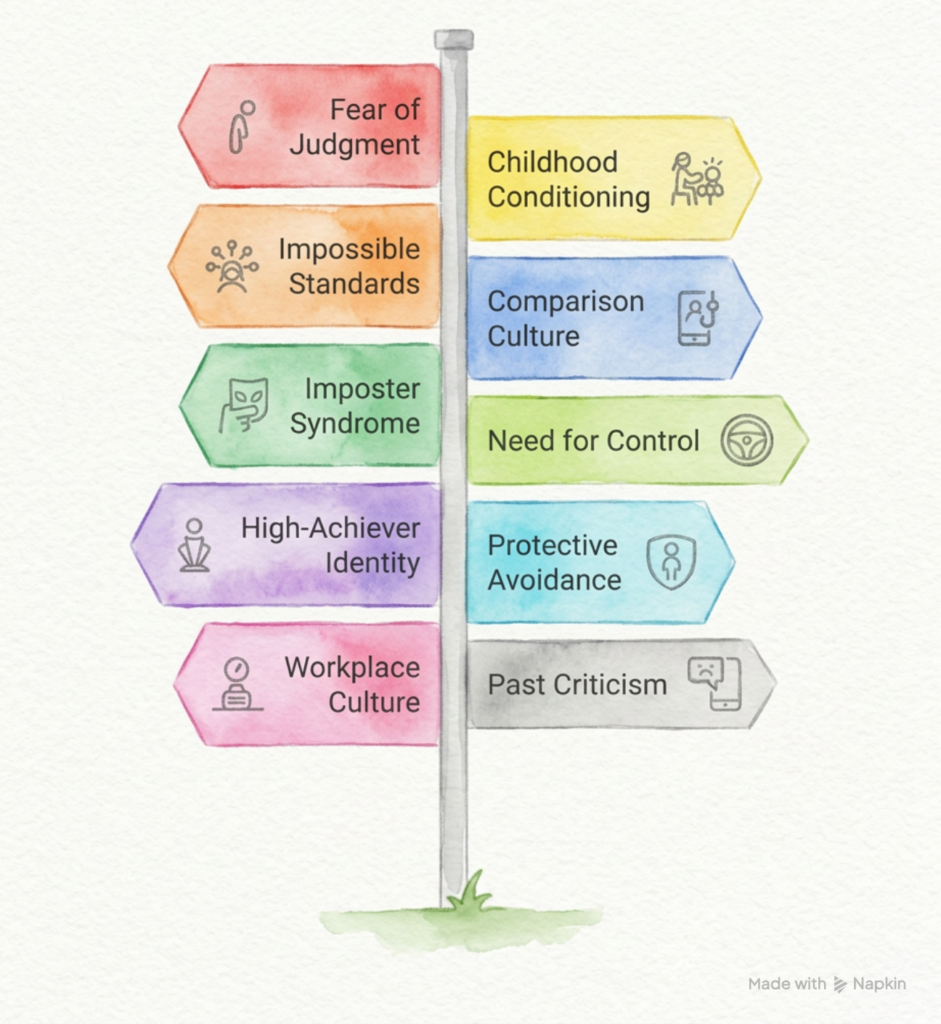
Perfectionism is often rooted in a desire for approval and a fear of judgment, two things women in particular have been conditioned to care about. Many of us were praised early for being “good girls” who did things “just right.” No wonder mistakes feel like an allergic reaction. That conditioning isn’t serving us anymore.
It also hides well. “I just have high standards,” we tell ourselves. But excellence and perfectionism are different things. Excellence motivates. Perfectionism paralyzes. Excellence celebrates progress. Perfectionism demands flawlessness. Excellence is about growth. Perfectionism is about proving worth. Confuse the two and we end up exhausted, stuck, and wondering why our high standards don’t feel better.
Four ways to break the cycle
Practice “good enough” on low-stakes tasks. The email to your colleague doesn’t need to be Pulitzer-worthy. The birthday cake might have lopsided frosting, and it will still taste delicious. Notice that the world doesn’t end when things aren’t flawless. Most people are too wrapped up in their own worries to scrutinize your work as closely as you fear.
Put a clock on it. Instead of “I’ll work on this until it’s perfect,” try “I’ll give this 45 focused minutes.” When the time is up, move on. Nothing is ever truly finished. There is always something to tweak. A time limit gives the tweaking a boundary.
Be imperfect on purpose. Choose something small and do it imperfectly. Send the email with a typo (the horror!). Go to the grocery store without makeup. Let the laundry sit unfolded for a day. Then notice that the catastrophe you expected never shows up. A little practice shrinks the fear back to its real size.
Use the five-minute rule. If procrastination has already set in, tell yourself you’ll work on the dreaded task for five minutes, and then you can stop. Starting is usually the hardest part. Once you begin, momentum often carries you forward. If it doesn’t, you’re still five minutes further along than you were.
Talk to yourself like a friend
Perfectionism treats mistakes as proof that we’re unworthy instead of a normal part of being human. When you catch yourself thinking “I have to get this exactly right or I’m a failure,” ask two questions. Would I judge a friend this harshly? Would I expect perfection from someone I love? Chances are you’re holding yourself to standards you’d never impose on anyone else.
Moving away from perfectionism doesn’t mean lowering your standards. It means accepting reality and giving yourself the compassion you’d give a friend. A life spent pursuing perfection is a life half-lived, always waiting in the wings for a moment that never arrives.
So today, give yourself permission to be imperfect. Start the project knowing it won’t be flawless. Send the email before you’ve proofread it seventeen times. Wear the outfit without checking it from every angle. The freedom on the other side isn’t about doing less or caring less. It’s about living more.
Done is better than perfect.